
What Is Change Leadership?
Change leadership is how leaders guide people through change: setting direction, building trust, and helping people adapt to what’s new. It’s the human side of change, focused less on the plan and more on whether people understand it, believe in it, and can act on it.
Most definitions agree on two points. Change leadership is people-focused, and it’s ongoing rather than tied to a single project. It also overlaps with adaptive leadership, which asks leaders to help their teams take on problems that don’t have a known answer.
Where the standard definitions fall short is in what they describe. They tell you what a change leader does: communicates the why, collaborates, inspires. They rarely say what keeps a leader doing those things when the pressure doesn’t let up.
Consider a leader who announces a reorganization, explains the reasoning, and checks in with the team every week until things settle. That’s change leadership for one change, and it works.
Now picture the same team absorbing a reorg in March, a new AI workflow in June, and a strategy shift in October, with no point where anything settles. That second version is what most leaders are living. It’s also the one the standard definition wasn’t written for.
To see why that matters, start with the discipline change leadership grew out of.
What’s the Difference Between Change Management and Change Leadership?
Change management is the structured process for moving people through a defined change: plans, timelines, communication, training, and adoption tracking. It answers the question, “How do we get this rollout done?”
Change leadership is the ongoing, people-focused work of setting direction and building trust. It answers a different question: “How do we help people keep moving when the ground keeps shifting?”
The most important difference is simple. Change management assumes the change has an end. Change leadership has to work even when it doesn’t.
John Kotter drew this line himself back in 2011, describing change leadership as the engine organizations would need as windows of opportunity began “coming at us faster, staying open less time”. His prediction came true, and then some. Today, many of those windows never close.
Here’s a practical example. A company rolling out a new performance review system needs change management: a timeline, training, communications, and adoption tracking. The same company’s sales managers, whose tools, targets, team structure, and AI assistant have changed three times in eighteen months, need change leadership. There’s no rollout date to manage toward.
The table below compares the two, along with a third approach we’ll come back to later in this post.
How change management, change leadership, and Compounding Leadership compare.
| Change Management | Change Leadership | Compounding Leadership | |
| Assumes change is… | A project with an end | Ongoing, but still a series of changes | The permanent condition |
| Focuses on | Process, timelines, adoption | Vision, communication, trust | The leader’s identity |
| Built on | Models like Lewin, Kotter, ADKAR | Skills and competencies | An identity rooted in values and beliefs, tested against real pressure |
| Success looks like | On-time adoption | Buy-in and engagement | Behavior that holds under pressure, and gets stronger |
| Under constant pressure | The next project restarts the cycle | Skills can revert to old habits | Each pressure event builds capability |
| Development looks like | Training for a rollout | Workshops and competency models | Ongoing: peer group coaching plus 1:1 coaching |
The models behind change management aren’t wrong. They were built for a different world.
Change Management Models Were Built for Change That Ends
The best-known change management models have earned their place. They’ve guided organizations through mergers, system rollouts, and major restructurings, and they still help with discrete projects. For anyone building change management for leaders, they’re a reasonable place to start.
But look closely at how each one ends.
Lewin’s Change Model: Unfreeze, Change, Refreeze
Kurt Lewin’s model, developed in the 1940s, is one of the earliest. Organizations first unfreeze old ways of working, then move through the change, then refreeze the new way so it sticks. The third step is the steady state, made literal.
Kotter’s 8 Steps
John Kotter’s model runs from creating a sense of urgency to the eighth step, Institute Change. Kotter Inc. describes that final step as “making sure they continue until they become strong enough to replace old habits”. New behaviors need a stable stretch of time to set.
The ADKAR Model
Prosci’s ADKAR model moves people through Awareness, Desire, Knowledge, Ability, and Reinforcement. Reinforcement assumes there’s a settled new state to reinforce. (William Bridges’ Transition Model follows the same arc, ending in a “New Beginning.”)
All three models depend on the same thing: a gap between changes, a period where the new way of working can settle in. That gap has disappeared.
Picture a finance team adopting a new forecasting process. They’re past “unfreeze” and working through “change.” Before anything can refreeze, an AI forecasting tool arrives, and the process changes again. The model’s third step never comes.
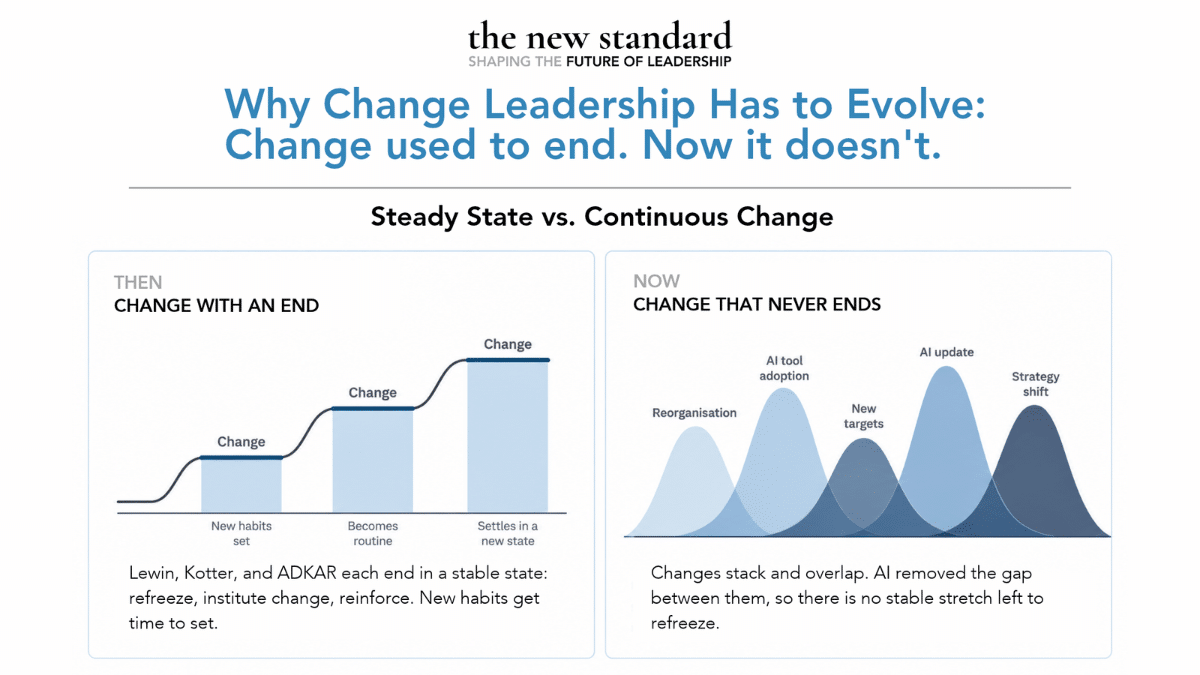
So what closed that gap? Change was already stacking up. AI made it continuous.
How Has AI Changed the Nature of Change?
AI didn’t just add another change to the list. It changed the nature of change itself, making disruption continuous rather than occasional.
Other forces were already piling change on. Restructuring, economic and political uncertainty, and new ways of working all added to the load. Remember that the jump from 2 to 10 planned changes a year happened before generative AI. There’s little reason to think the count has slowed since.
What AI changed is the gap. Even frequent changes used to arrive and then settle. AI-driven change doesn’t settle. The tools keep updating, and each change creates the next one. That’s what makes change continuous and compounding, not just frequent.
The scale is hard to overstate. Nearly nine in ten organizations now use AI regularly in at least one business function, and the share of large enterprises scaling AI agents jumped from 27% to 40% in a single year (McKinsey, The State of AI, 2026).
Gartner’s research points to the same shift. As Kayla Velnoskey, a director in Gartner’s HR practice, put it, “Changes today are continuous, stacked on top of one another, highly interdependent and often driven by factors external to the organization” (Gartner, 2025).
Here’s how that looks on the ground. In January, a team adopts an AI assistant for drafting. By spring, it handles first-pass analysis. That changes what the analysts spend their time on, which changes what their manager reviews, which changes how performance gets measured. No single change was big. Together, they never stop.
This is why leading through change now looks so different from even five years ago. For a closer look at what this means for managers, see how AI is exposing the leadership gap.
The market’s response has been to shift from change management to change leadership. Here’s why that alone isn’t holding.
Why Change Leadership Skills Still Revert Under Pressure
The market’s answer to continuous change has been more skills. Communicate the why. Collaborate. Build trust. Commit. Models like the Head, Heart, and Hands model give leaders a fuller picture of what change asks of them, and it’s genuinely useful advice.
The trouble is what happens to those skills when pressure hits. A leader can know exactly what to do and still fall back on old habits when the deadline arrives. We call this the Reversion Effect.
The Reversion Effect is the tendency for leaders to return to familiar behaviors under pressure, even after they’ve committed to leading differently. (We explore it in depth in why leaders revert under pressure.)
Continuous change makes the Reversion Effect worse. When change came in waves, leaders had time to recover between them. When it’s constant, there’s no recovery window. Each reversion just resets them.
The data reflects this. Only 8% of executives demonstrate strong change leadership, according to DDI’s assessment of more than 100,000 leaders (DDI, 2026). And 79% of employees report low trust in organizational change, while only 32% of leaders say the last change they led achieved healthy adoption (Gartner, 2025).
Consider a manager who learns in a workshop to explain the why and bring her team into decisions. It works through the first reorg. By the third change of the year, with a deadline looming, she makes the calls herself and takes the work back. She didn’t forget the skill. Her identity was still “the one who gets it done,” and under pressure, identity wins.
That’s the core issue. Leaders revert to who they believe they are. Skills layered on top of an old identity don’t survive sustained pressure.
Our Q2 Practitioner Report looks more closely at why capable leaders revert under pressure, and what development that actually holds looks like.
If skills aren’t the anchor, what is?
What Is Compounding Leadership?
Compounding Leadership is leadership built on a clear identity, rooted in values and beliefs that have been tested against real pressure. Instead of resetting every time conditions change, a leader’s capability builds: each pressure event, once noticed and corrected, leaves them stronger for the next one.
At its core, Compounding Leadership is about identity: who a leader is, not just what they know how to do. It isn’t one more belief added to a skills list. It’s an identity shift.
That identity is rooted in a leader’s values and beliefs, meaning what they hold to be true about people and about leadership, independent of their role or company. Those are what stay constant when the org chart, the strategy, and the tools all change.
The word “tested” matters. Values written on a worksheet don’t hold up when a deadline hits. Values that have been tested against real pressure, and supported afterward, do.
And that’s where the “compounding” comes in. Each pressure event becomes a rep. When a leader notices the pull toward old habits and chooses differently, the next time gets easier. Capability builds instead of starting over.
Here’s what that looks like. A leader believes people rise when they’re trusted with real ownership. When urgency hits, the pull is to take the work back. A leader anchored in that belief notices the pull and chooses differently. Every time they do, the next time gets easier.