

Why It Happens
Start with the biological floor. Under cognitive load, the brain prioritizes speed and protection, reaching for well-practiced pathways over recently learned ones. That’s well established, and it’s why so much writing on stress and leadership stops right there.
It’s not the whole story, though, and stopping there misses the part that really matters to an L&D buyer. Under pressure, the brain reaches for a specific pattern: that person’s pattern, not just any old habit. Reversion is identity-consistent, not generically regressive. Two managers under identical pressure, with identical training, will revert to different behaviors, each to the version of themselves that was rewarded before they ever led anyone. That specificity is what a purely neurological explanation can’t account for.
The peer-reviewed evidence supports this at scale. In a study of 304 employees rating their leaders separately under routine and stressful conditions, Klebe, Klug & Felfe (2022) found a real, measurable gap in how the same leader showed up, and that gap widened when the leader was under more strain. The inconsistency itself hurt the people being led, independent of whether the leadership was good or bad in either state, which reframes reversion from a disappointing training outcome into an organizational risk in its own right.
We’ve seen the same thing from the practitioner side. Across our coaching team, 30 coaches working in dozens of different organizations, different industries, systems, and cultures, have independently reported the same pattern. That kind of convergence, across genuinely different environments, is hard to explain any other way.
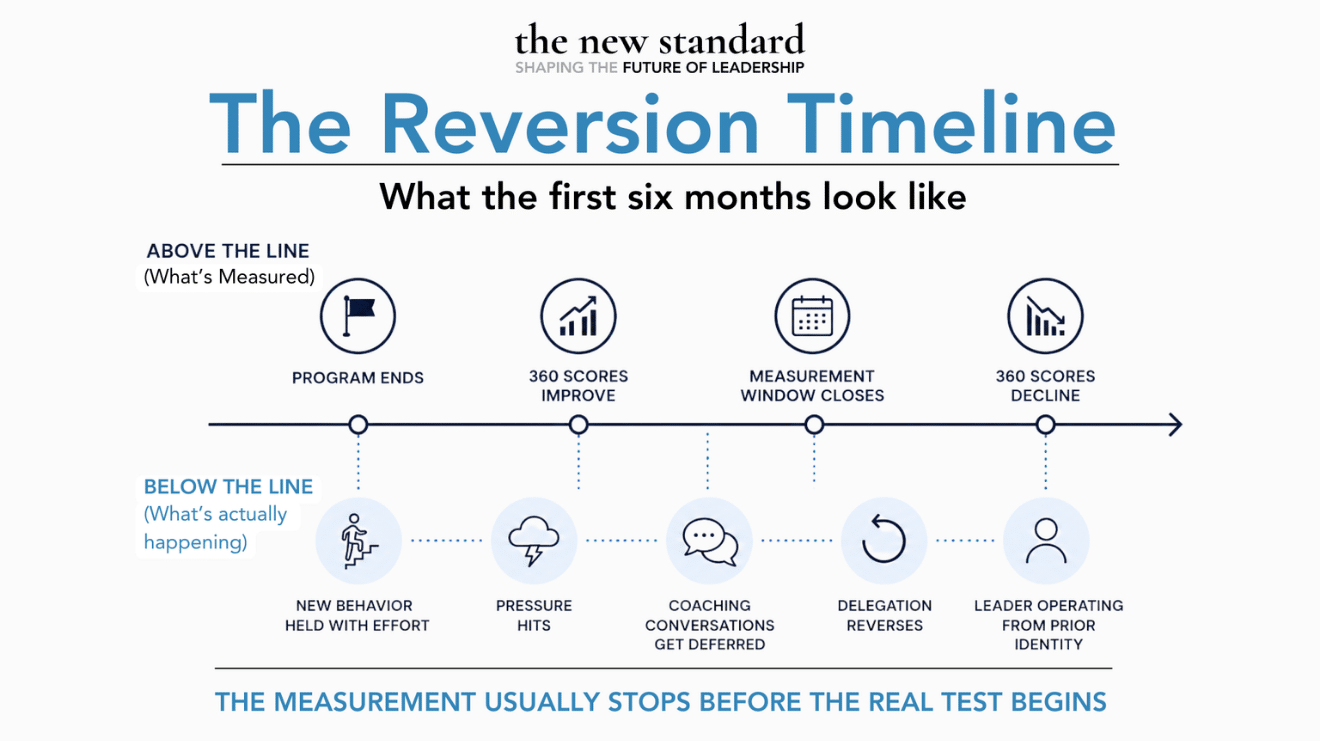
What reversion looks like before you can name it:
- Coaching conversations go first. They’re the least identity-native behavior a leader has, and the easiest thing to defer when the calendar tightens.
- 360 scores improve, then decline. The measurement window usually closes before the real pressure test arrives.
- Delegation reverses. The leader starts taking work back without ever deciding to.
Why the Common Fixes Don’t Hold
Three explanations dominate the conversation about why leadership development doesn’t stick, and each one is held by serious people for good reason. Each is also partly right, which is exactly why they’re worth taking seriously before showing their limits.
More skills training.
This is the default assumption, and it’s the quickest one to rule out. It fails because the skills were already there. The manager who reverted could still run the coaching conversation; they simply chose not to. Knowing how was never the constraint. (We made a version of this argument in our post on why knowing your DiSC style isn’t the same as changing how you lead.)
System alignment.
This is the most credible of the three, and it’s the position held by the field’s leading professional body: leaders don’t return from a program to a blank slate, they return to a system, and if that system contradicts the new behavior, the behavior fades. This is largely true, and it genuinely helps. But the limit is precise: aligned systems reduce reversion without eliminating it, and the variance that remains tracks the person, not the environment. That’s exactly what the 30-coach observation tells us: the pattern shows up across very different systems, which means it isn’t a property of any single one of them.
Reinforcement.
Handle this one carefully, because reinforcement genuinely works, and the decay data supports using it. The problem is what reinforcement is aimed at. Reinforcement aimed at behavior, layered on top of an unchanged self-concept, builds scaffolding. Scaffolding holds, right up until the pressure exceeds it or the scaffolding comes down.
What all three fixes share is an assumption: that the leader is still selecting a response. Better skills give them more to select from. Better systems give them a better environment to select within. Better reinforcement strengthens what they’ve already selected. All three require conscious selection at precisely the moment conscious selection is least available.
What Really Interrupts It
If skills, systems, and reinforcement aren’t sufficient on their own, what is?
Identity change requires action under real conditions, sustained over time, not reflection alone. Herminia Ibarra’s research on leadership transitions supports this directly: her outsight principle holds that leaders think their way into a new identity only after acting their way into it, and the final stage of that transition is internalization. The Reversion Effect is what shows up when pressure arrives before internalization has finished.
Ibarra’s data also explains why so few leaders manage this transition on their own. In her 2013 INSEAD survey, only 47% of leaders facing a major change in what was expected of them had actually been promoted into a new title; the rest were expected to lead at a bigger scale with no new title and no formal support, a shift she calls the do-it-yourself transition. Most leaders can’t generate the right conditions for that kind of change alone. That’s precisely why development has to build those conditions deliberately.
What are those conditions? Sustained duration instead of a single event. Real working conditions instead of a classroom. Peer witness. External reflection from someone who won’t let the drift pass unnoticed, the kind of structure you also see in adaptive leadership approaches built for conditions leaders haven’t faced before.
What that structure actually looks like, and how it’s built, is a bigger question than this post can answer. It’s the whole reason the next one exists.
What This Means If You Develop Leaders
If you’re responsible for a development budget, the Reversion Effect gives you a sharper set of questions for your next program review:
- Are we measuring change at program completion, or under pressure?
- Does the design put leaders in conditions where the old identity is likely to resurface?
- What happens between sessions, and for how long after the program ends?
- Are we developing the identity, or just decorating it?
This distinction is measurable. In our own practitioner data, programs built around this approach have shown 82% sustained behavior change measured under pressure, and 90% three-year retention against an industry baseline closer to 65%, a 25-point gap. (This is preliminary practitioner research and carries a self-selection caveat, but it points at what’s possible when development is built for real conditions instead of ideal ones.) It’s a pattern worth watching alongside what tends to happen to high performers who stall out and start looking elsewhere.
The Handoff
The manager in that first vignette didn’t forget the training. Somewhere along the way, they stopped being the person who used it.
Ibarra’s answer to stepping into a bigger leadership identity has three parts: redefine your job, redefine your network, redefine your leadership identity. The first two are well understood and widely practiced. The third is the one almost nobody knows how to build deliberately.
That’s the subject of the next post.