

Table of Contents
Key Takeaways
- AI isn’t creating a new management problem. It’s exposing one that has existed since organizations began promoting their best performers into management roles.
- When AI automates approximately 43% of standard managerial tasks, what remains is pure leadership: the human work most managers were never formally developed to do.
- Organizations are closing the training gap but not the change management gap; 64% have AI training programs, but only 35% have structured change management in place.
- The Reversion Effect, when managers revert to pre-program behavior under pressure, is the mechanism behind most development program failures. Skills training without identity-level change produces temporary results.
- The right question for L&D leaders isn’t “what do our managers need to learn?” It’s “who do our managers believe they are, and is that identity capable of what AI-era leadership requires?”
Picture this: A manager in your organization completes your most recent leadership cohort. They show up differently in their 360 feedback. Their team engagement scores tick up. Their skip-level conversations become substantive. Three months later, you’re sitting in a quarterly review and the performance data tells a different story: directive behavior is back, coaching conversations have stopped, and the team is hitting its numbers by working around the manager instead of through them.
If you’ve watched this pattern play out once, you’ve probably watched it play out a dozen times. And if you’re a CHRO, L&D director, or VP of People at a mid-to-large organization, you already know the frustration: the programs aren’t failing because they’re poorly designed. Something else is happening.
The conversation about AI and middle management keeps circling the wrong question. The question isn’t whether AI will replace managers. The question is why the development we’re investing in isn’t producing the results we need, and why that gap is becoming impossible to ignore in an AI transformation environment.
This post names the mechanism. It won’t solve the problem in 2,000 words. But it will give you language for something you’ve been observing for years.
The Promotion Model That Built Today’s Manager Crisis
The management layer most organizations are working with today wasn’t designed. It accumulated.
For decades, the path into management followed a simple logic: find the best performer on the team and give them a team. The person who knew the most, produced the most, solved problems the fastest, that person became the manager. It was a rational reward system. It was also a structural miscalculation that organizations are still paying for.
The Chartered Management Institute’s Better Management Report puts a number to it: 82% of UK managers receive no formal preparation for the people management aspects of their role. That’s not a gap that appeared last year. It predates AI by decades. These are people who were selected, promoted, and rewarded for expertise and individual output and then handed accountability for developing other people without the development, the preparation, or often even the interest in making that transition.
What we refer to as the High Potential Trap captures this paradox precisely. The qualities that make someone a standout individual contributor, drive, technical mastery, ownership, and the urgency to solve, are precisely the qualities that undermine them as leaders when they can no longer rely on personal output.
This is the management layer your L&D programs are working with. The question isn’t whether your managers are capable people. They almost certainly are. The question is whether the identity they built their careers around is the right foundation for the leadership AI is now making necessary.
The Gallup State of the Global Workplace puts the downstream cost of this gap at approximately $8.9 trillion annually in global employee disengagement, roughly 9% of global GDP. The management layer isn’t performing as a people-development engine. The data has been saying so for a long time.
AI didn’t create this problem. It just made it impossible to manage around.
AI Just Removed the Last Place to Hide
A manager whose value to the organization was built around knowing things, synthesizing information, tracking progress, and solving problems efficiently is now operating in an environment where AI does all of those things faster and more consistently than any human can.
BearingPoint’s 2025 survey of over 300 managers across Europe and the US found that approximately 43% of standard managerial tasks are impacted by generative AI — 19% augmented, 24% automated. MIT Sloan Management Review research shows that AI tools deliver productivity gains of 40% or more for knowledge workers, primarily by automating information synthesis and retrieval. These aren’t speculative projections. They’re current data on what is already happening in the organizations your managers work in.
When AI handles the information layer, the task management layer, and the routine problem-solving layer, what remains is the manager’s essential human function: developing people, creating psychological safety, navigating ambiguity, enabling performance, holding the team’s direction when conditions are unclear. Pure leadership.
This is the “lights on” moment the title refers to. The manager who was promoted for expertise was always underprepared for pure leadership. The gap was always there. AI has removed the tasks that were covering for it: the busyness, the information advantage, the role of being the person who knew the most or moved the fastest. What’s left is the human work. And for a significant portion of the management layer in most organizations, that’s precisely the work they were never developed to do.
The Observer framed this well: “Knowledge is no longer power because knowledge is ubiquitous.”
The Development Response That Isn’t Working
Organizations have not ignored this. Most mid-to-large companies have been running leadership development programs, deploying AI literacy training, investing in coaching certifications, and rolling out operational playbooks for managers navigating the transition. The investment is real. So why aren’t the results sustaining?
BearingPoint’s data points to a structural gap: 64% of organizations have AI training programs for their managers. Only 35% have structured change management programs in place. The 29-point difference isn’t a funding problem or a prioritization failure. It’s a diagnostic problem. Organizations are treating a change problem as a knowledge problem.
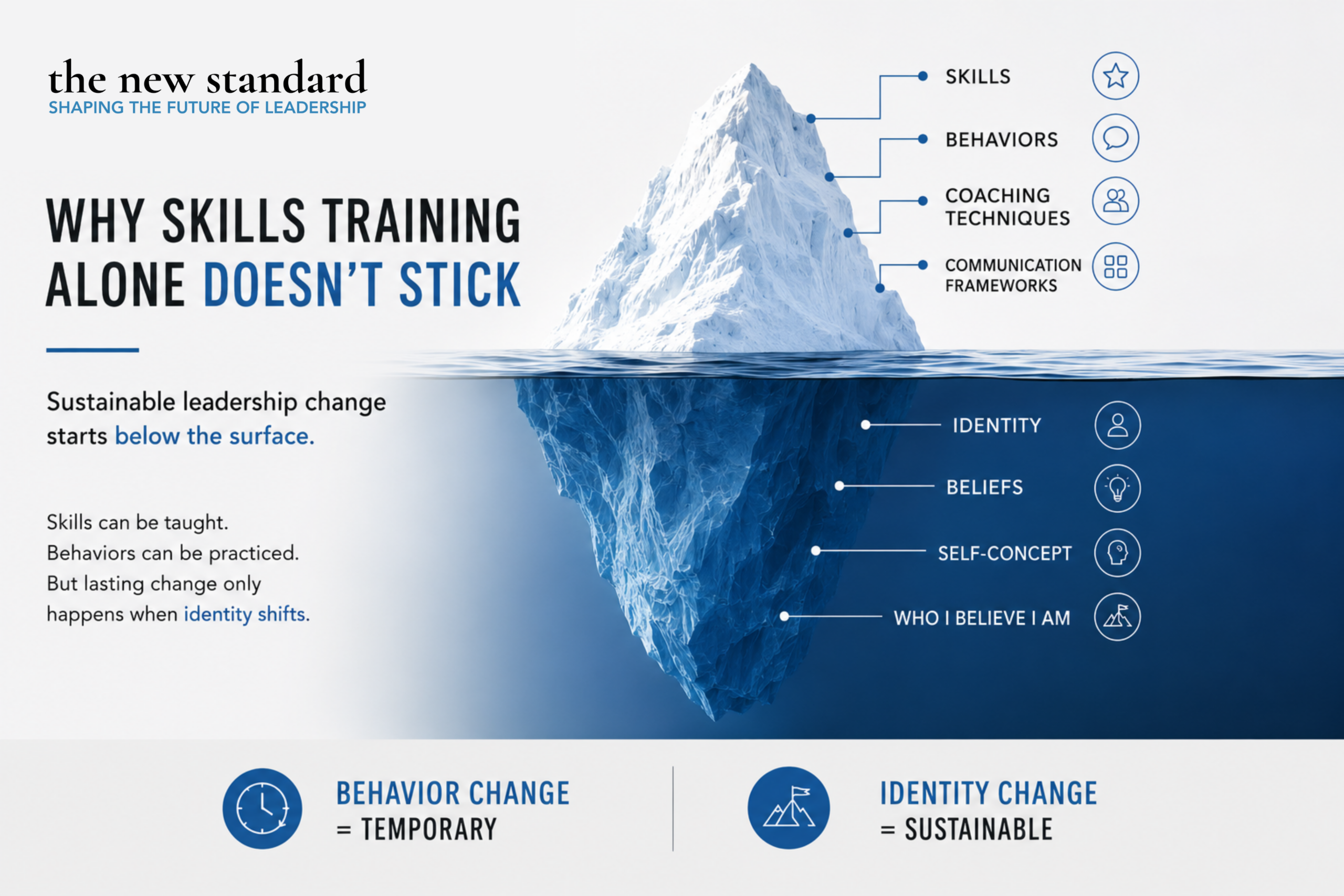
Even the change management programs that do exist tend to develop leadership as an overlay: techniques applied on top of the manager’s existing identity. Coaching frameworks. Communication workshops. 360-feedback cycles. AI literacy modules. These are valuable. They’re also insufficient on their own.
Talisha Padgett, who leads B2B MarTech Platforms and AI at Microsoft, put the structural piece precisely in a 2026 MarTech article: managers need decision rights, role-specific training with “operational playbooks with options and routes,” and meaningful metrics that reflect AI-driven decisions made, not just tool login rates. That framing is correct and useful. But structural enablement doesn’t resolve what happens when a manager who has been “the doer” for their entire career hits a deadline and defaults back to directive behavior. Decision rights don’t change what the manager reaches for when the pressure is highest.
What happens in that moment has a name. We call it the Reversion Effect.
The Reversion Effect: Why Change Doesn’t Survive the First Pressure Test
The Reversion Effect is the consistent pattern in which managers who complete development programs demonstrate behavioral change in program conditions, then revert to pre-program behavior when they encounter real organizational pressure such as a missed deadline, a performance conversation, a period of organizational uncertainty, or any moment when the stakes feel high enough that old instincts reassert.
It’s not a failure of will. It’s not a failure of the program content. It happens because skills-based development addresses what managers do without changing who they believe they are.
A manager whose professional identity is built around being the expert, the problem-solver, the one who drives results through personal execution, that manager, under pressure, will default to directive behavior. This doesn’t happen because they forgot the coaching model from the program, but because in the moment that’s what matters most, the identity that has kept them safe and successful for years reasserts. The pre-program identity is more deeply encoded than the program-acquired behavior.
What we observe consistently across the programs we run is that this pattern isn’t outlier behavior, it’s the norm when development operates at the behavioral level without reaching the identity level. The Observer’s work with LSE found a 70% increase in coaching time after behavioral training. That’s a meaningful result within a program window. But a behavior metric measured during or shortly after program completion doesn’t tell us what happens 12 months later when conditions make reverting easiest.
The BearingPoint 64%/35% data is, in a very specific sense, the Reversion Effect quantified at the organizational level: 29 percentage points of organizations that have training but not the structural and identity-level infrastructure to make it stick. McKinsey’s podcast research made the same point from a different angle, explicitly warning against sending burned-out managers to retreats, observing that the timing is wrong. The instinct is right. The analysis stops one step short: the problem isn’t timing. Programs tend not to address identity regardless of when they run.
The full mechanism behind the Reversion Effect, what happens neurologically and psychologically, and what conditions interrupt it, is the subject of the next post in this series. What matters here is the name and the framing: this is not a failure of effort, funding, or intent. It’s a predictable outcome of development that operates at the wrong level.
What Sustained Change Actually Looks Like
The question the L&D buyer is carrying at this point in the post is a fair one: if the current approach isn’t working, what is the evidence that something else does?
In the programs we run, and in the longitudinal data we collect from cohorts 12 months post-program, a different picture emerges.
- 82% of participants demonstrate sustained behavior change at 12-month follow-up. We’re not talking about program completion data or a 30-day post-program survey. Behavioral observation at 12 months, when real organizational conditions, not program conditions, are the environment.
- 9 times the promotion rate versus the baseline population among program completers. Not changed behavior in a feedback form, but organizational recognition of genuine leadership capacity.
- 95% three-year retention among program participants. Identity-level change produces organizational commitment, not just behavioral compliance.
The comparison that matters is not between TNS and any competitor. It’s between what these metrics measure and what most development programs measure. The Observer’s LSE data showed a 70% increase in coaching time. That’s a meaningful and valuable outcome. But it’s a behavior metric inside or shortly after a program window. TNS measures whether coaching behavior persists when conditions make reverting easiest. That’s a different question. It requires a different kind of development.
The difference isn’t a new technique or a better framework. The difference is that this development addresses not just what managers do, but who they believe they are when the doing gets hard. That distinction, identity-first versus skills-first development, is the subject of the third post in this series. Here, the relevant point is simpler: the outcome data exists. It doesn’t exist in the same form anywhere else in the category.
The Question L&D Leaders Should Be Asking Right Now
AI turned the lights on. The leadership gap was already there. It was built into the promotion model, encoded in how organizations selected and rewarded individual contributors, visible in the Gallup disengagement data that has been accumulating for years. AI removed the tasks that were covering for it and made the gap structural and urgent.
Most organizations are asking: “What skills do our managers need in an AI world?” That question leads to training programs, literacy workshops, and operational playbooks. Some of those are genuinely useful. None of them address the fundamental issue.
The more useful question is this: who do our managers believe they are, and is that identity capable of the leadership that AI is now making necessary?
If your managers believe they are the expert, the solver, the driver, if that identity has been reinforced by decades of promotion decisions and performance reviews, then the most sophisticated development program in the market will produce behavior change that doesn’t survive the first performance crisis. Not because your managers aren’t capable. Because development that doesn’t reach the identity layer can’t interrupt the Reversion Effect.
This is the moment when L&D leaders either address what they’ve been managing around for years, or continue to optimize a system that is producing the results it was designed to produce, just not the results the organization needs.
We documented what we’re seeing across our program cohorts in this year’s Practitioner Report, including the data behind why some managers make the identity shift and most don’t. Download The High Potential Trap — Q2 2026 Practitioner Report
The next post in this series goes further into the Reversion Effect and looks at what it takes to interrupt it, and what the neurological and psychological research says about why identity-level development produces different results.
Is Your Management Layer Ready for What AI has Exposed?
Frequently Asked Questions: AI and Middle Management
Will AI replace middle managers?
AI won’t replace middle managers, but it will expose which managers were genuinely leading and which were managing through information control and task oversight. As AI automates up to 43% of standard managerial tasks, what remains is pure leadership: developing people, creating psychological safety, and enabling performance. Managers who built their value around the work AI is now doing face a real identity challenge.
How does AI affect middle management?
AI affects middle management primarily by automating the tasks most managers have relied on for organizational value: information synthesis, task assignment, progress tracking, and routine problem-solving. MIT Sloan research shows AI tools increase knowledge worker productivity by 40% or more through this automation. The result is that the manager role distills to its human core and most managers were promoted for technical expertise, not people leadership readiness.
Why do high performers struggle when they’re promoted to management?
High performers are typically promoted for technical excellence and individual output, the qualities that make them valuable as contributors. But those same qualities often undermine them as managers. When a leader’s identity is built around being the expert and the problem-solver, the shift to developing others, creating space, and enabling rather than doing requires a fundamentally different way of seeing their own role. This is what we refer to as the High Potential Trap.
How can L&D leaders develop management skills that actually stick?
Most leadership development programs produce short-term behavior change that doesn’t sustain under real organizational pressure. The reason isn’t the quality of the program. It’s that skills-based training addresses what managers do without changing who they believe they are. Development that produces lasting results operates at the identity level, not just the behavioral level. The question isn’t “what skills does this manager need?” but “who does this manager need to become?”
What is the Reversion Effect in leadership development?
The Reversion Effect is the consistent pattern in which managers who complete development programs demonstrate behavioral change in program conditions, then revert to pre-program behavior when they encounter real organizational pressure: deadlines, performance conversations, conflict, resource constraints. It occurs because skills-based development changes behavior without changing identity. When conditions get hard, the manager’s pre-program identity reasserts. Identity-first development is designed to interrupt this pattern.
What does sustained behavior change in manager development actually look like?
Sustained behavior change means managers continue to demonstrate new leadership behaviors 12 months after program completion, not just during or immediately after the program. The differentiating factors include whether the development addressed identity (who the manager believes they are) and not just skills (what they know how to do). In the programs we run, 82% of participants demonstrate sustained behavior change at 12-month follow-up, compared with the industry norm of measuring outcomes at program completion or 30-day follow-up.
The New Standard is a leadership development organization focused on identity-first development for managers and senior leaders. Our Q2 2026 Practitioner Report, “The High Potential Trap,” documents the research behind the patterns described in this post.
Sources: BearingPoint (Middle Managers and AI-Driven Transformation, March 2025, survey of 300+ managers across Europe and the US); MIT Sloan Management Review; Chartered Management Institute Better Management Report; Gallup State of the Global Workplace; TNS Q2 2026 Practitioner Report (proprietary cohort data).
Enjoyed this post? You might also like…