

The High Potential Trap: When Your Greatest Strength Becomes Your Greatest Risk
Most people don’t burn out because they lack commitment. They burn out because they have an abundance of it.
High-performing leaders tend to be reliable, accountable, and deeply invested in their work. They are the people others trust to solve difficult problems, rescue struggling projects, and deliver results under pressure. Those qualities are often recognized and rewarded with greater responsibility.
Over time, however, the very behaviors that created success can begin working against them.
Instead of building systems that allow others to succeed, they become the system. They answer every question, solve every problem, and quietly absorb work that belongs elsewhere because they know they can do it well. Eventually, their role becomes defined less by leadership and more by personal execution.
We call this pattern The High Potential Trap.
The High Potential Trap is the tendency for an organization’s most capable people to plateau or burn out because their sense of value remains tied to what they personally produce.
The trap develops gradually, which is why many leaders don’t recognize it until they’re already exhausted.
Perhaps you hesitate to delegate because it’s faster to complete the task yourself. Maybe you routinely revise work before allowing anyone else to see it, or you find yourself stepping in whenever a team member struggles. You may even feel uneasy taking time off because you worry things won’t move forward without you.
None of these behaviors signal a lack of leadership potential. In fact, they often develop because you’ve spent years proving that you are dependable.
The difficulty is that the leadership behaviors required to earn a promotion are not always the same behaviors required to succeed after you’ve been promoted.
Gallup reports that nearly three out of four employees experience workplace burnout at least sometimes, and managers have experienced one of the steepest declines in workplace engagement in recent years. Many of those managers are exactly the people organizations depend on the most. They continue performing at a high level long after the personal cost has become unsustainable.
Why High Performers Experience Burnout Differently
The World Health Organization defines burnout through three primary characteristics: exhaustion, increased mental distance or cynicism toward work, and reduced professional effectiveness.
For high-performing leaders, those symptoms often appear differently than they do for everyone else.
Exhaustion is easy to recognize. The other two can remain hidden because performance often stays high. Instead of producing less, high performers simply expend more effort to produce the same results.
From the outside, they appear successful. Internally, they are operating with less capacity, less resilience, and less room for strategic thinking than ever before.
This helps explain why two leaders can experience the same workload and respond very differently.
Traditional explanations often point toward personality. Some people are naturally perfectionists. Others struggle to let go of control or feel responsible for everything around them.
Those observations describe the pattern, but they stop short of explaining why it exists.
In our experience, these behaviors are better understood as expressions of identity than fixed personality traits.
Many high performers gradually begin to equate their value with their usefulness. Their confidence becomes closely connected to being the person who solves problems, delivers exceptional work, and remains indispensable to the team. Once that identity takes hold, slowing down becomes emotionally difficult because it no longer feels like taking a break. It feels like stepping away from the very thing that makes them valuable.
That is why conventional recovery strategies often produce only temporary relief.
Why Rest Alone Doesn’t Create Lasting Recovery
Rest is necessary.
Healthy boundaries matter. Sleep matters. Exercise matters. Time away from work matters.
Ignoring those needs only accelerates burnout.
At the same time, many leaders discover that even after they feel physically rested, they quickly recreate the same conditions that exhausted them in the first place.
They return from vacation determined to delegate more effectively. Within days they have reclaimed projects because someone wasn’t moving quickly enough. They promise themselves they won’t answer emails at night, then convince themselves this week is an exception. They begin protecting their calendar until another urgent request arrives and pushes strategic work aside.
None of this happens because they lack discipline.
It happens because pressure activates familiar patterns.
The challenge with burnout is that recovery often focuses on restoring energy without changing the behaviors that continually deplete it.
Organizations contribute to burnout as well. Unrealistic workloads, unclear priorities, and poor leadership systems all play a role. Addressing those issues is essential.
But many leaders cannot wait for their organization to change before beginning their own recovery.
That is where identity becomes so important.
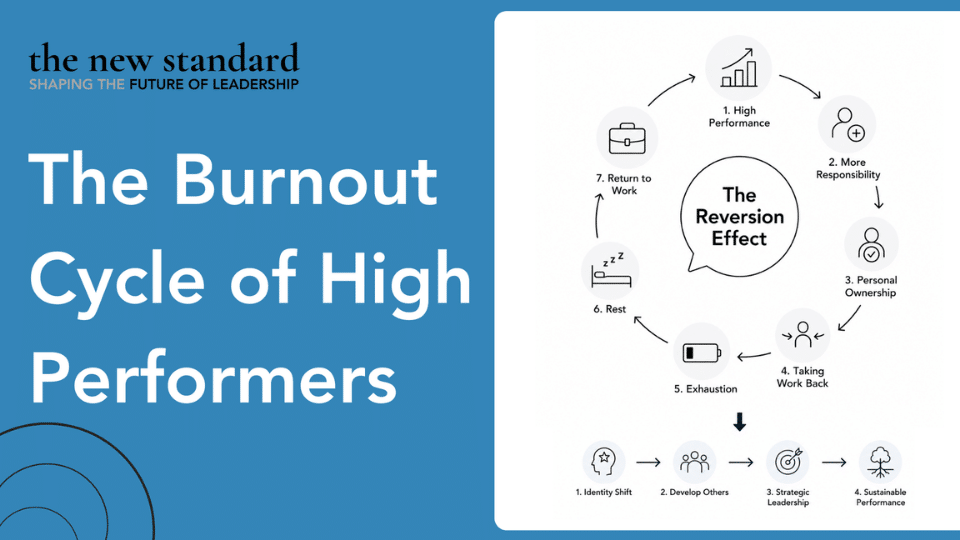
The Reversion Effect: Why Change Doesn’t Last
One of the most consistent patterns we’ve observed among leaders is what we call The Reversion Effect.
The Reversion Effect is the tendency for leaders to return to personal execution whenever pressure increases, even after they’ve committed to leading differently.
Imagine a leader who has worked hard to delegate responsibilities across the team. Everything is progressing well until an important deadline approaches, a team member begins struggling, a client requests revisions, or priorities suddenly shift.
Without much conscious thought, the leader takes the work back that they previously delegated.
From a short-term perspective, the decision feels reasonable. The project moves faster. The quality improves. The deadline is protected.
The hidden cost is that the leader has once again reinforced the belief that success depends on personal effort rather than collective capability. The more often this cycle repeats, the more difficult it becomes to break.
Understanding the Reversion Effect shifts the conversation away from willpower and toward awareness. Instead of asking, “Why can’t I stop doing everything myself?” leaders begin asking, “What belief am I protecting by stepping back into this work?”
That question opens the door to a different kind of recovery.
What Recovery From Burnout Looks Like
Lasting recovery does not require becoming less ambitious or lowering your standards. It requires redefining what leadership means.
Early in a career, success often comes from personal expertise. You are recognized because you produce exceptional work.
As responsibilities grow, however, leadership becomes less about what you accomplish personally and more about what you enable other people to accomplish. That transition sounds straightforward, but for many leaders it requires an identity shift.
Instead of measuring your value by how much you produce, you begin measuring it by the capability you build in others. Delegation becomes an investment rather than a risk. Coaching replaces rescuing. Strategic thinking becomes possible because your calendar is no longer consumed by work someone else could own.
This change rarely happens overnight. It develops through repeated choices that feel uncomfortable at first because they challenge long-standing beliefs about success.
In our programs, we have observed that leaders who make this identity shift report more sustainable behavior change under pressure than those who focus exclusively on developing new skills. While this practitioner research is still undergoing review, it reinforces something we have seen consistently over many years: lasting leadership change begins with identity.
Where to Start
If you recognize yourself in these patterns, resist the urge to overhaul everything at once. Instead, begin paying attention to the moments when you feel compelled to step back into the work.
Ask yourself a simple question:
Is my value coming from what I personally produce, or from what I enable others to achieve?
That question often reveals more than another productivity system ever could.
Continue prioritizing rest, boundaries, and your physical wellbeing. Those practices remain essential. At the same time, begin examining the beliefs that drive your decisions under pressure. Sustainable recovery depends on both.
If burnout has become severe or is affecting your physical or mental health, seek support from a physician or qualified mental health professional. Leadership development and healthcare play different but equally important roles in recovery.
Burnout is not a sign that you care too much or work too hard. For many high-performing leaders, it is a signal that the definition of success that once served them has reached its limit.
The next stage of leadership requires something different. Not less ambition, but a broader understanding of where your value truly comes from.