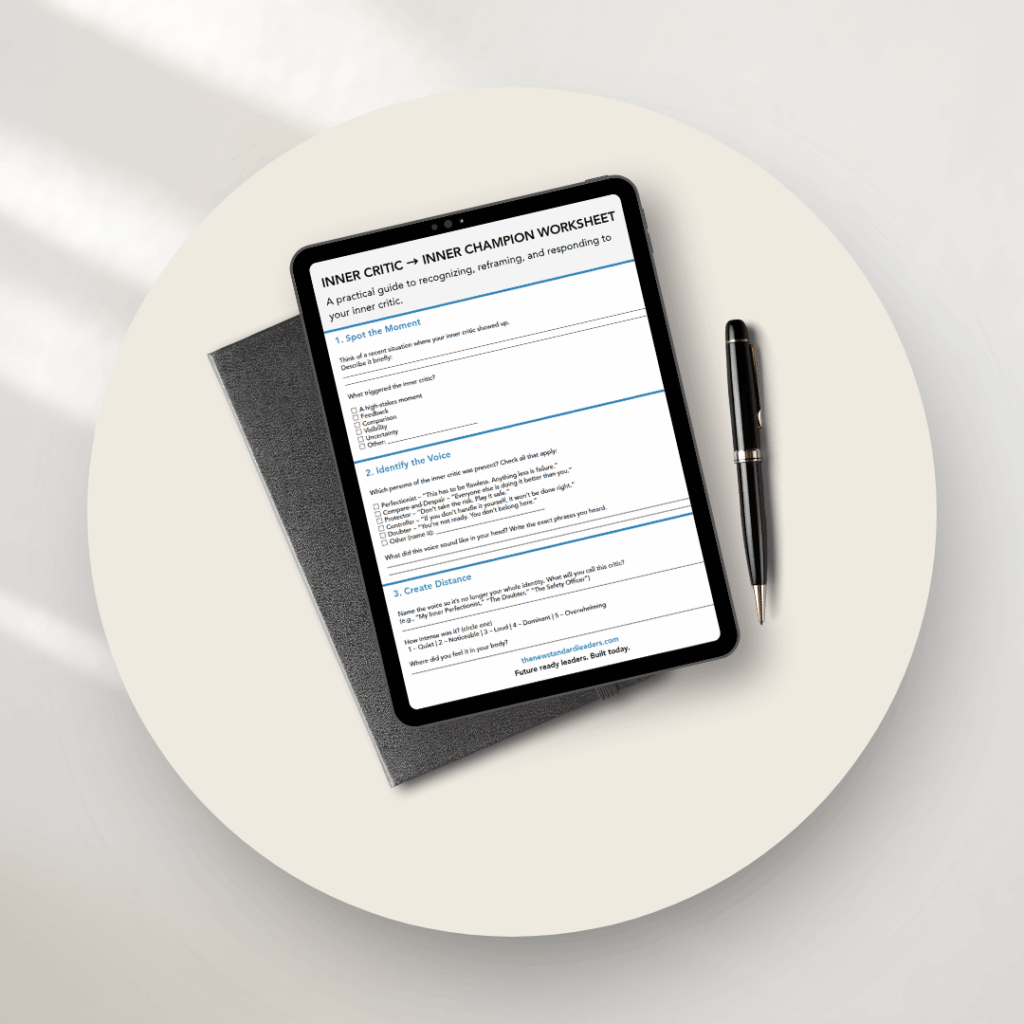

The inner critic is more than a whisper. For leaders, it can be a force that distorts decisions, muffles presence, and saps confidence. Yet, it is not the enemy. It is a signal, a deeply embedded part of the mind that, when understood, can be channeled into strength.
At The New Standard, our work with leaders consistently reveals the same pattern: accomplished professionals who lead high-performing teams still wrestle with a voice that says, “If I mess this up, they’ll see I don’t belong.” That voice matters. The work to tame it matters for the leader and for the organization.
Key Takeaways
- Nearly every leader experiences an inner critic. It’s that internal voice that questions decisions, raises doubt, and can steal confidence at critical moments.
- Recognizing the inner critic is the first step toward turning self-doubt into actionable insight. Simply noticing the voice creates the space to respond differently.
- The inner critic shows up in many forms: perfectionist, over-preparer, people-pleaser, or self-saboteur. Knowing your type helps you respond rather than react.
- Working with the inner critic through reflection, self-compassion, and deliberate reframing allows leaders to act with clarity, presence, and influence.
- Cultivating an inner champion shows up in how leaders lead teams, make decisions, and shape organizational culture.
Understanding the Inner Critic
The inner critic is the internal voice that appears during high-stakes moments: before a board meeting, a tough conversation, or when deciding to take a big leap. It might say: “You’re not ready,” “If you try this, you’ll fail,” or “They’ll realize your flaws.” That voice does not spring from nowhere. It is shaped by early experiences, prior failure, professional pressure, and internalized expectations.
For the leaders we work with at The New Standard, the critic often shows up as over-preparation, self-silencing, or second-guessing. They report rewriting emails and over-rehearsing presentations not because the work is weak, but because the critic warns them about being judged. It’s a constant, quietly distracting companion, one that competes with vision, clarity, and influence.
The Impact of the Inner Critic on Leaders
Turning down voice of the inner critic is not optional for those who lead. It has real consequences:
- Decisions suffer. When the critic dominates, leaders can over-analyze or avoid bold choices.
- Presence weakens. Self-doubt erodes authenticity. A leader pulled inward by their critic struggles to show up powerfully.
- Teams feel the impact. Hesitation to delegate, or fear of speaking up, slows momentum and reduces trust.
- Innovation shrinks. The critic often discourages risk, limiting creative thinking and stretch goals.
When leaders begin to work with their critic rather than fight it, they gain clarity, make stronger decisions, and lead more confidently. Awareness becomes a competitive edge.
Recognizing Different Forms of the Inner Critic
We’ve seen leaders identify different personas of their inner critic:
- The Perfectionist: This critic demands flawless execution and equates mistakes with failure.
- The Compare-and-Despair: This voice measures success by comparison, always suggesting someone else is better.
- The Protector: It warns against failure, risk, and visibility, often out of a misplaced sense of caution.
- The Controller: It resists delegation, insisting that only the leader can do the job “right.”
- The Doubter: Fueled by imposter-syndrome, this critic questions readiness, qualifications, and belonging.
Understanding which persona is active makes it possible to respond strategically rather than reactively.

How the Inner Critic Impacts Brain & Performance
Internal self-talk is not merely mental chatter. It shows up in the brain.
There’s strong evidence that self-criticism and self-compassion are deeply linked to how people regulate emotions. In a 2024 study of 453 participants, greater self-compassion was associated with lower emotional dysregulation, helping to buffer the negative impact of self-criticism.
These findings are relevant for leaders because managing what the inner critic says doesn’t just make them feel better. It’s engages different parts of the brain in ways that support focus, decision-making, and resilience.
How to Turn Your Inner Critic Into a Leadership Tool
Here’s how leaders can transform their inner critic into an inner champion:
1. Name the Voice
Call out the critic when it appears. “That’s the Perfectionist speaking,” or “This is my Doubter kicking in.” Naming it builds distance. It’s no longer your entire identity, just one among many.
2. Practice Observational Awareness
Use brief mindfulness or reflection breaks to observe what the critic is saying, without merging with it. Notice the voice saying ‘I’m not good enough,’ then step back and observe it without letting it take over your thoughts or actions.
3. Ask the Question That Matters
Instead of “What could go wrong?” ask, “What is this voice trying to protect me from?” Often, the critic is guarding something real: safety, reputation, or legacy.
4. Use Self-Compassion Language
Replace harsh self-judgment with gentle truth. For example, “Even if I make a mistake, I have handled hard moments before,” or “It’s okay to learn rather than perform perfectly.”
5. Reframe Into Action
Use the critic’s energy as data. If the critic warns of failure, reframe: “That risk feels real, but I choose to prepare and act anyway.” If the critic doubts competence, pivot: “I will learn and delegate, not control everything.”
6. Anchor to Evidence
Build a mental (or written) list of past wins, instances of resilience, and positive feedback from others. When the critic attacks, revisit your proof.
7. Visualize the Inner Champion
Imagine a voice that supports growth, confidence, and trust, a voice that says, “I can do this. I will grow from this.” Visualizing this helps the champion voice become stronger and more natural.