
Strategic thinking is one of the most cited and least clearly defined expectations placed on leaders. Many are told to “be more strategic,” yet few receive practical guidance on what that actually looks like in day-to-day decision-making and prioritization.
That gap matters. Research consistently identifies strategic thinking as a top leadership capability, yet one of the hardest to develop. Organizations that elevate how strategy is understood and practiced are better able to navigate uncertainty while setting direction that lasts. McKinsey’s work with companies across industries finds that only a small fraction consistently deliver high-quality strategy, and the ones that do are more effective at making decisions that hold up over time and support sustained performance.
At The New Standard (TNS), we see strategic thinking not as an abstract ideal or a rare trait, but as a capability leaders can develop. The leaders who strengthen it can make sense of complexity and align teams around what matters most.
Key Takeaways
- Strategic thinking is a skill set that can be learned and strengthened with practice.
- Effective leaders balance strategic and tactical thinking. They are not interchangeable.
- Strategic thinking improves decision quality, alignment, and adaptability.
- Leaders develop strategic thinking by creating space, asking better questions, and engaging diverse perspectives.
- Organizations can intentionally build cultures that support strategic leadership.
What Is Strategic Thinking?
Strategic thinking is the ability to understand the broader context in which decisions are made, anticipate potential consequences, and choose actions that connect immediate priorities to long-term goals. It involves analyzing information across systems, identifying patterns, and weighing trade-offs to guide effective decision-making.
Strategic Thinking in Leadership
In leadership roles, strategic thinking shows up long before a plan is written. It’s visible in how leaders define the problem in front of them, where they choose to focus limited time and resources, and how they bring clarity to messy, high-stakes situations. As McKinsey’s research on strategy shows, leaders today are operating in environments shaped by constant change and interdependence, which means the quality of their thinking, not just the quality of their execution, determines outcomes.
In practice, strategic thinking in leadership looks like this:
- Framing problems before jumping to solutions
- Choosing where attention and resources will (and won’t) go
- Turning complexity into a small set of clear priorities
- Balancing immediate pressures with longer-term impact
We see this play out consistently in our work at TNS. Leaders who slow down enough to map competing priorities often uncover misalignment before it becomes a bottleneck. Others use simple scenario thinking to anticipate how a single decision might ripple across teams or functions. Over time, it’s these small, deliberate choices that shape outcomes.
Why Strategic Thinking Matters
Every day, leaders juggle changing priorities, urgent problems, and unexpected challenges. Strategic thinking helps them pause, see the bigger picture, and set a clear course instead of just reacting.
Leaders who think strategically tend to:
- Make higher-quality decisions under pressure
- Create stronger alignment across teams and functions
- Adapt more effectively to change
- Anticipate challenges before they escalate
Studies show that organizations that tie day‑to‑day decisions and resource allocation to long‑term strategic priorities are much more likely to translate goals into value and outperform their peers on growth and returns. Leaders who keep both “now” and “next” in view help ensure that daily actions consistently support where the organization needs to go.
Leaders who strengthen their strategic thinking learn to make more deliberate, clearer choices even when the path isn’t fully defined. And that ability to pause, reflect, and act with intent is what separates reactive leadership from leadership that drives true impact in organizations.
Core Strategic Thinking Skills for Leaders
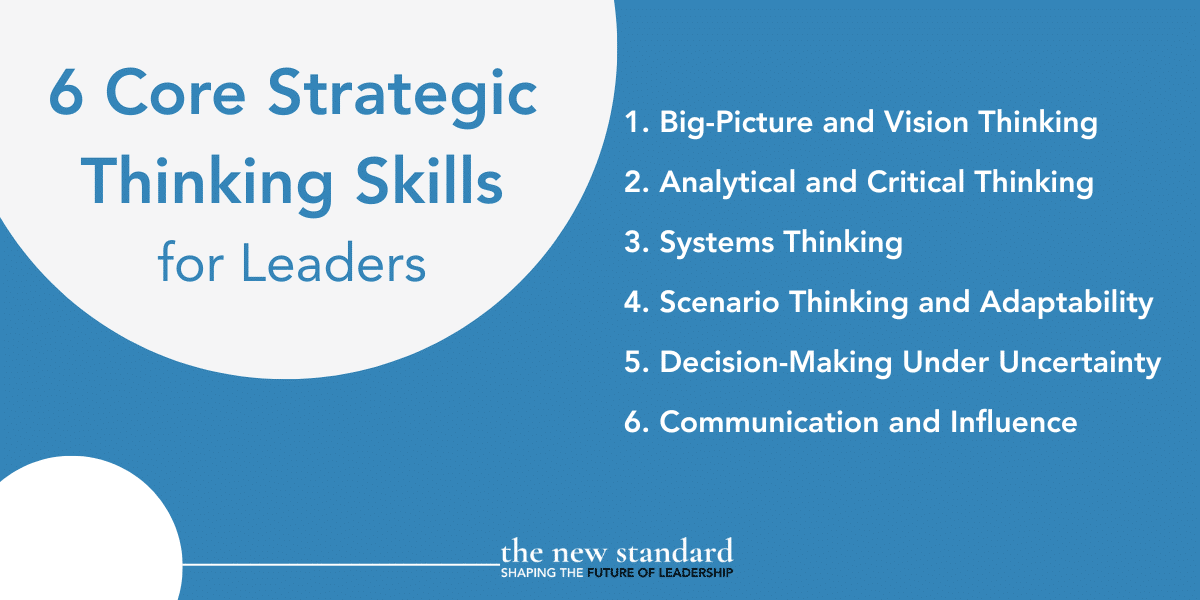
Strategic thinking is composed of several interrelated capabilities that leaders develop over time:
1. Big-Picture and Vision Thinking
Seeing beyond immediate tasks to understand how work connects to broader organizational goals.
2. Analytical and Critical Thinking
Evaluating information, identifying patterns, and testing assumptions rather than relying on instinct alone.
3. Systems Thinking
Understanding how different parts of an organization influence one another and how decisions ripple across teams and stakeholders.
4. Scenario Thinking and Adaptability
Exploring multiple possible futures and remaining flexible as conditions change (IMD).
5. Decision-Making Under Uncertainty
Weighing trade-offs, risks, and consequences when outcomes are not guaranteed.
6. Communication and Influence
Translating strategic insight into clarity that others can understand and act on.
Each skill helps leaders see how daily choices shape bigger outcomes and navigate complexity deliberately.
Strategic Thinking vs. Tactical Thinking: Why Leaders Need Both
Strategic thinking and tactical thinking are often positioned as opposites, but effective leadership requires both.
| Strategic Thinking | Tactical Thinking |
| Long-term focus | Short-term execution |
| Direction-setting | Task completion |
| Explores “why” and “what if” | Focuses on “how” and “when” |
| Navigates ambiguity | Operates within clarity |
Tactical thinking ensures work gets done. Strategic thinking ensures the work matters.
Overcoming Barriers and Developing Strategic Thinking
Even experienced leaders face obstacles that can limit strategic thinking in leadership, but these challenges are far from insurmountable. At TNS, we guide leaders to recognize common barriers and adopt practical habits that strengthen their strategic thinking muscle over time.
Lack of Time:
Leaders get pulled into urgent tasks, leaving little space to reflect. Schedule even 60 minutes per week to review priorities and assess trade-offs.
Short-Term Pressure:
Immediate targets dominate. Ask, “If this works today, what’s the impact six months from now?”
Organizational Silos:
Teams act in isolation. Seek cross-functional input and map dependencies.
Familiarity Bias:
Relying on past practices can blind leaders. Test alternatives and run mini scenario exercises.
Strategic thinking isn’t reserved for a few. Those who step back, question, and refine their decisions create bigger impact from daily actions.
Strategic Thinking in Action: A Leadership Example
A senior leadership team at a growing organization was busy, but stuck. Projects were on track and metrics met, yet meetings dragged, decisions stalled, and teams weren’t aligned. Execution looked strong, but the real issue was focus: each function was chasing urgent tasks without clarity on how their work connected to bigger priorities.
Instead of adding processes or meetings, we helped the team step back and clarify shared outcomes. They mapped priorities, spotted overlaps, and agreed on a few directional bets that truly mattered. Conversations shifted. Leaders stopped debating daily tasks and started evaluating how decisions advanced long-term objectives.
The impact was clear. Decisions moved faster, trade-offs became obvious, and teams aligned around what really mattered. They didn’t do more work. Instead, they thought differently. By making space to reflect, challenge assumptions, and link daily actions to long-term goals, the team turned competing priorities into coordinated action and strengthened their strategic thinking muscle.
Strategic thinking isn’t about doing more. It’s about pausing, questioning, and acting with intent to turn everyday choices into meaningful impact.
Tools and Frameworks That Support Strategic Thinking
Leaders don’t have to rely on intuition alone. A few structured approaches can help make complex decisions more deliberate:
SWOT Analysis:
Highlights internal strengths and weaknesses alongside external opportunities and risks. Leaders use it to clarify where to focus energy and where to mitigate challenges.
Scenario Planning:
Explores multiple potential futures to challenge assumptions. It helps leaders anticipate risks and identify opportunities before they become urgent.
Systems Mapping:
Visualizes how teams, processes, and functions are interconnected. Leaders use it to see the ripple effects of decisions across the organization.
Trend Analysis:
Examines external forces (market, technology, or social trends) that could impact strategy. This ensures decisions take the external environment into account.
These tools don’t replace judgment or reflection. They structure it.
Building a Culture of Strategic Thinking
Strategic thinking escalates when organizations design for it.
Cultures that support strategic leadership:
- Reward thoughtful inquiry, not just speed
- Invite multiple areas to weigh in on the ripple effects of changes
- Create space for discussing long-term implications alongside short-term results
- Normalize questioning assumptions and exploring alternatives
In our experience, organizations that intentionally develop strategic thinking see stronger alignment, engagement, and adaptability over time. Leaders who cultivate this environment make it easier for teams to connect daily decisions to long-term outcomes and navigate complexity with confidence.
How to Improve Strategic Thinking Skills
For leaders looking to put strategic thinking into practice, there are several ways to continue building the skill:
Watch this short video exploring how leaders balance strategic perspective with operational demands.