

Key Takeaways
- Leadership decision-making is a deliberate, learnable capability.
- The decisions leaders make directly impact organizational culture, trust, and long-term performance.
- Structured frameworks and tools increase clarity, speed, and reliability.
- When leaders recognize how bias, fatigue, or missing information show up, they make better calls under pressure.
- Effective leaders balance collaboration with decisive ownership.
Why Leadership Decisions Matter
Leaders spend an estimated 40% of their time making decisions. That is an enormous investment of time and energy, often under conditions of incomplete information, competing priorities, and real organizational pressure.
Every decision a leader makes—about people, strategy, or allocating resources—creates ripple effects well beyond the moment of choice. It shapes momentum, trust, execution, and ultimately results.
At The New Standard, we see decision-making as a capability that strengthens through practice, reflection, and structured approaches. In our work with leaders across industries and around the world, one theme comes up consistently: organizations need leaders who can make tough decisions through complexity and uncertainty, not just when conditions are clear.
That capability requires more than good judgment. It requires resilience: staying aligned with organizational goals while acting confidently amid incomplete information and sustaining trust with teams. We’ve seen firsthand that leaders who deliberately cultivate this capability make higher-impact choices and create steadier, more effective organizations.
So when we see data suggesting that, in aggregate, a typical Fortune 500 company loses more than 500,000 workdays each year to ineffective decision-making, we don’t treat it as inevitable. We see it as a call to create a different reality—for the leaders we work with and for the organizations they serve.
A Practical Framework for Leadership Decision-Making
Strong decision-making under pressure doesn’t call on instinct alone. It requires a repeatable way to think, especially when the stakes are high and the variables are many.
At The New Standard, we use and teach The TNS Decision Framework to help leaders bring rigor, clarity, and confidence to complex decisions. This framework isn’t a checklist. It’s a disciplined structure leaders rely on when decisions are charged, ambiguous, or consequential.
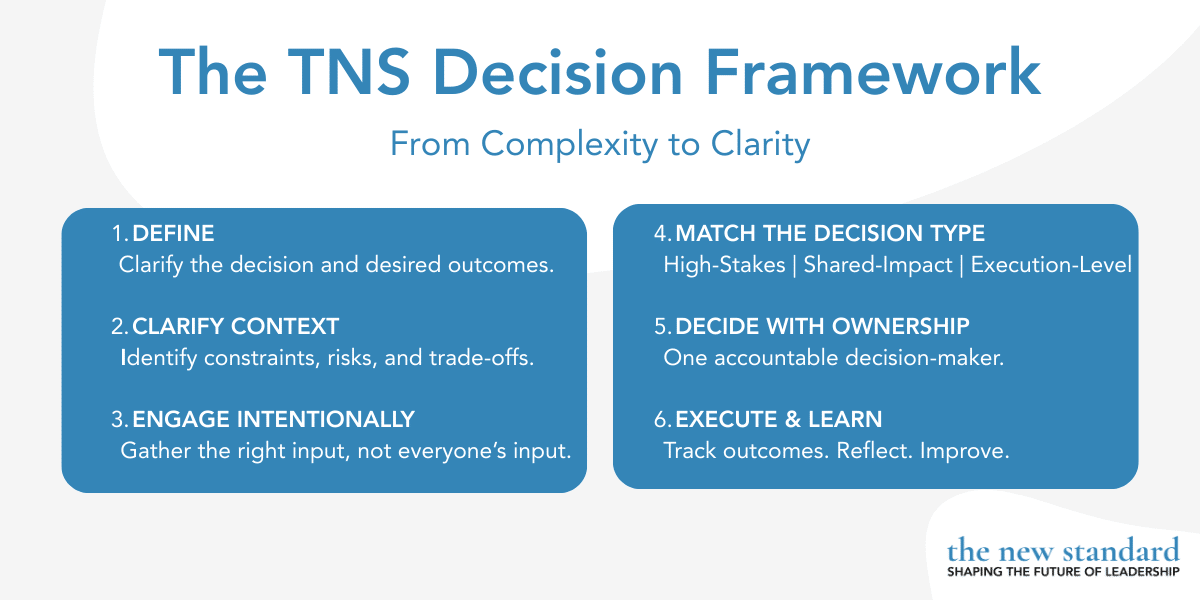
1. Define the Decision
Clarify the decision that needs to be made, the outcomes that matter, and the level of urgency involved. Vague or loosely framed decisions tend to stall or splinter during execution.
2. Clarify Context and Constraints
Surface strategic priorities, constraints, risks, and trade-offs. Leaders must be explicit about what is fixed versus flexible in order to make decisions that align with organizational reality.
3. Gather the Right Perspectives
Strong decision-making does not mean seeking input from everyone. It means intentionally engaging those whose expertise, experience, or proximity to the work will surface insights or unintended consequences—especially across cultures, functions, or markets.
4. Match the Approach to the Type of Decision
Not all decisions require the same level of rigor, involvement, or speed. In our work, we help leaders distinguish between three types:
- High-Stakes Decisions: Decisions with significant risk, visibility, or long-term consequences. These warrant deeper analysis, broader perspective, and explicit ownership. For example, entering a new market, restructuring a division, or selecting a long-term strategic partner.
- Shared-Impact Decisions: Decisions that affect multiple teams, functions, or stakeholders. These succeed when leaders create alignment without defaulting to consensus. For example, shifting cross-functional priorities, launching a company-wide initiative, or redesigning a core process that spans departments.
- Execution-Level Decisions: Decisions best made close to the work. These should be intentionally delegated with clear boundaries to enable speed and accountability. For example, adjusting a project timeline, resolving a client escalation, or reallocating team resources within an approved plan.
5. Decide and Communicate Clearly
Once a decision is made, ownership matters. Leaders must communicate the rationale, expectations, and next steps with clarity. Transparency builds trust, even when outcomes are uncertain.
6. Execute, Monitor, and Learn
The decision itself is only the beginning. Leaders should track outcomes, surface lessons, and reflect on what worked and what did not. This reflection turns individual decisions into organizational learning.
Common Challenges Leaders Face
Even experienced leaders encounter predictable barriers. Recognizing them early allows for proactive strategies. The patterns listed below are the ones we see most frequently in our work with leaders across industries and regions, and the challenges we actively discuss and address in our programs.
| Challenge | Signs | How We Coach Leaders to Overcome |
| Cognitive Bias | Favoring familiar solutions or early information | Structured frameworks, soliciting dissenting views, pre-mortem analysis |
| Decision Fatigue | Slowed or postponed choices | Prioritize high-impact decisions, delegate appropriately |
| Lack of Clarity | Undefined ownership or objectives | Define decision scope and owner upfront |
| Over-reliance on Consensus | Endless discussion without action | Balance input with decisive leadership |
| Incomplete Data | Gaps in information | Combine best-available data with expert judgment and scenario planning |
These patterns are consistent across regions and sectors: even high-performing leaders need deliberate structures to avoid predictable pitfalls.
Involving Others Effectively
Collaboration is powerful, but only when it’s intentional. Leaders must strike the right balance between gathering input and acting with urgency.
- Engage stakeholders early for complex, high-impact decisions.
- Limit contributors when speed is critical.
- Escalate selectively, only when broader authority or enterprise alignment is required.
We recently worked with a mid-level leader in the banking sector who was responsible for rolling out a major cross-platform initiative affecting multiple regions and teams. The stakes were high, and she felt the pressure. Early on, she fell into a common trap: trying to involve everyone in every decision. Meetings multiplied and key milestones were slipping. Her project team grew frustrated, and momentum stalled. She brought it up in one of her executive coaching sessions in Accelerate.
Her coach helped her to map decisions to their type and identify which required broad input versus delegated action. Strategic platform changes became High-Stakes Decisions, involving regional leads and compliance experts early on. Smaller implementation choices became Execution-Level Decisions, delegated to team leads with clear boundaries. This approach allowed her to accelerate decision-making, maintain accountability, and still benefit from diverse perspectives—all without overloading herself or the organization.
We call this approach intentional involvement: ensuring decisions are informed and inclusive while avoiding the trap of “decision by committee.” Leaders who master this skill are better positioned to move initiatives forward efficiently while keeping teams aligned and engaged.
After the Decision: Execution, Accountability, Learning
Strong decision-making doesn’t end once a choice is made. The quality of execution, the clarity of accountability, and the insights leaders extract afterward determine whether a decision creates lasting impact.
1. Follow Through with Intent
Even the best decision can fail if it isn’t executed properly. Leaders set clear next steps, assign responsibility, and define success metrics. This ensures that everyone understands what to do, by when, and why it matters.
2. Maintain Accountability
Ownership is critical. Leaders check in consistently, track progress, and remove obstacles that might prevent teams from achieving results. Accountability reinforces trust, aligns behavior with goals, and signals that decisions are taken seriously.
3. Reflect and Learn
Decisions are opportunities for growth. Leaders who take time to reflect by considering what went well, what didn’t, and why, will turn individual decisions into organizational capability. Techniques like post-mortems, structured team debriefs, or simple lessons-learned logs help surface insights and sharpen judgment for future choices.
Key reflection questions:
- Did the decision achieve intended outcomes?
- Were there unexpected consequences?
- How can future decisions be improved?
This process strengthens both individual judgment and organizational decision-making capability over time.
Building Decision-Making Capability at Scale
Strong individual decision-makers are not enough. Organizations need decision clarity embedded into how work gets done through defined decision rights, shared frameworks, and consistent leadership expectations.
When this discipline exists across levels, speed and accountability increase naturally. Decisions are made closer to the work. Escalations decrease. Meetings become more focused. Ownership becomes clearer.
This is where leadership development becomes organizational infrastructure. Programs like Accelerate and Fast Track help leaders apply a common decision framework, clarify accountability, and act with confidence under pressure. Over time, that shared approach strengthens alignment across teams and functions, and shifts decision-making from a recurring frustration into a competitive advantage.
If better, faster decisions are a priority, the work must extend beyond individual skill-building. It must be built into the system.
If your organization is ready to reduce friction, accelerate execution, and strengthen leadership impact, explore how Accelerate and Fast Track can help build decision-making capability where it matters most.