

Key Takeaways
- Worrying about what others think is often a signal of unclear leadership identity rather than low confidence.
- Approval-seeking behaviors can quietly limit leadership effectiveness.
- Research shows that self-aware leaders and organizations perform better.
- Clarifying your leadership philosophy creates a stable internal compass.
- Tools like the STOP method help leaders move from reaction to values-based action.
Leadership often means making decisions that won’t be popular. You might need to challenge a long-standing assumption, deliver difficult feedback, or propose a new direction when everyone else is comfortable with the status quo.
In those moments, many leaders catch themselves asking the same question: What will people think?
Maybe you’ve experienced it yourself: someone proposes an idea in a meeting that you don’t agree with. You have a different perspective, but you hesitate before speaking, scanning the room to see how your words might be received. In that brief pause, many choose silence.
The instinct to consider others’ reactions isn’t the problem — thoughtful leaders do this well. But when concern about others’ opinions becomes the main driver of behavior, subtle but important consequences emerge:
- Ideas go unspoken.
- Decisions take longer than they should.
- Difficult conversations get softened or postponed.
Leadership gradually shifts from guiding the organization to managing perception. Interestingly, this dynamic usually isn’t about confidence. More often, it comes down to clarity — clarity about the values and principles guiding how you lead.
The Hidden Cost of Approval-Seeking in Leadership
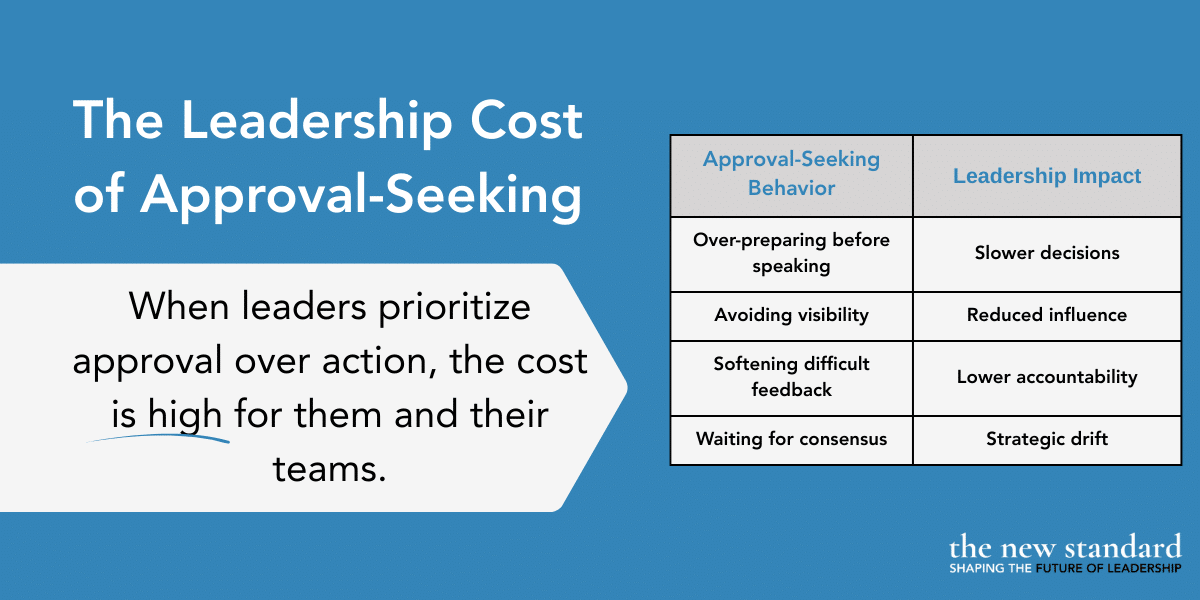
Approval-seeking rarely shows up as obvious insecurity at work. Instead, it tends to disguise itself as behaviors that appear thoughtful or responsible.
A leader might spend excessive time preparing before speaking in meetings to anticipate every possible objection. Someone else may soften difficult feedback in an effort to preserve relationships. Others avoid high-visibility opportunities because the scrutiny feels uncomfortable.
None of these behaviors look dramatic in isolation. But over time, they can quietly limit leadership impact. Decisions slow down, honest conversations become less frequent, and consensus begins to replace clarity.
Organizations ultimately depend on leaders who can provide direction when the path forward isn’t obvious. When leaders become overly focused on how their actions might be perceived, that direction becomes harder to provide.
Research reinforces the importance of internal clarity in leadership. A Korn Ferry Institute analysis of nearly 7,000 leadership assessments across 486 companies found that organizations with stronger financial performance tended to have professionals with fewer “blind spots”—a key indicator of self-awareness.
In other words, organizations where people have a clearer understanding of their strengths, limitations, and decision-making patterns tend to perform better. Approval-seeking, in many cases, is simply a signal that a leader’s internal compass is still developing.
Why “Just Be Confident” Doesn’t Work
Leadership advice often treats this challenge as a confidence problem.
The suggestion usually sounds something like: speak up more, trust yourself, stop worrying about what others think. While confidence can certainly help, it rarely addresses the deeper issue. Confidence that depends on external approval is inherently unstable. It rises when leaders receive positive feedback and shrinks when they encounter disagreement or criticism.
Without a clear internal framework for decision-making, people naturally look outward for signals about what is right. Approval, disagreement, praise, and criticism from others start to shape decisions more than internal conviction.
In our leadership development programs at The New Standard, we see this pattern frequently. Many participants initially describe their challenge as a lack of confidence. But as conversations deepen, it becomes clear that confidence is rarely the root issue.
What’s often missing is a clearly articulated set of leadership principles. Once leaders clarify the values guiding how they lead, many of the behaviors associated with low confidence, such as hesitation, over-preparing, and avoiding visibility, begin to fade.
Confidence grows much more naturally when leaders understand what they stand for.
Why This Is Harder Than It Sounds
If caring what others think were simply a mindset problem, the solution would be easy. But there’s a reason this dynamic shows up so consistently in leadership. Our brains are wired to care about social evaluation.
For most of human history, belonging to a group was essential for survival. Being rejected by the group could mean losing access to resources, protection, and safety. As a result, our brains evolved to detect and respond to social threat very quickly.
Modern neuroscience reflects this reality. In a widely cited study published in Science, researchers found that experiences of social rejection activate many of the same brain regions involved in processing physical pain.
In other words, the discomfort leaders feel when facing criticism or disagreement is not imagined. The brain interprets social threat in ways that feel very real. Understanding this can actually be helpful. It reminds us that the instinct to care about others’ opinions is normal.
Leadership growth comes from building enough clarity about who you are as a leader that the instinct to seek approval no longer drives your decisions.
Identity Before Confidence
Many high-performing leaders share a trait that isn’t always visible from the outside: they operate from a clearly defined leadership philosophy.
This philosophy goes beyond slogans or motivational phrases and provides a set of principles that guide how leaders make decisions, respond to pressure, and interact with others.
When leaders have this clarity, they still listen to feedback, but they’re less likely to let external opinions determine their direction. Developing that clarity often begins with reflection.
Three questions can help leaders start articulating their leadership philosophy:
- Values and principles: What values guide how I lead, and what principles do I refuse to compromise?
- Leadership impact: What impact do I want to have on the people I lead, and what experience should they have working with me?
- Decision-making under pressure: What principles guide my decisions under pressure? When the path forward isn’t obvious, what helps me determine the right course of action?
Answering these questions helps leaders develop a stable internal compass, which is something they can return to when pressure, criticism, or uncertainty appears.
| Reflection Area | Questions to Ask | Action Step / Prompt |
| Core Values | What principles do I refuse to compromise as a leader? | List 3–5 principles that guide your decisions daily. Highlight one you’ll consciously lean on this week. |
| Leadership Impact | What experience do I want people to have working with me? | Write down the top 2 experiences you want your team to consistently feel. Share one with a colleague or direct report for feedback. |
| Decision Principles | What guides my choices when the path forward isn’t obvious? | Think of 3 tough decisions you’ve made in the last few years. What were the beliefs you relied on? |
Leadership in Practice
In many of The New Standard’s leadership programs, participants take time to write a short statement that captures the principles guiding how they lead. It doesn’t need to be elaborate. Often it’s a single sentence that reflects the leader they want to be when pressure rises.
Examples include:
- Create clarity when others feel uncertainty.
- Lead with curiosity before judgment.
- Choose courage over comfort when it matters most.
Participants often return to this statement when they feel the pull of doubt or external pressure. It becomes a practical reminder of the leader they intend to be.
From Stress Response to Values-Based Action
Even leaders with a clear philosophy still experience moments of pressure. It could be a critical comment in a meeting, a difficult conversation with a colleague, or a high-stakes presentation. In those moments, the brain’s stress response can quickly push leaders toward caution or avoidance. Leadership development tools can help create a pause between reaction and action.
At The New Standard, participants learn the STOP method:
- Stop
- Take a breath
- Observe what is happening internally
- Proceed toward your values
That final step is where leadership identity becomes practical. Instead of asking “How will this be perceived?”, leaders begin asking a more useful question:
“What action aligns with the leader I want to be?”
That shift does not eliminate pressure. But it often creates the clarity needed to act with intention rather than hesitation.