

Most leaders have heard some version of the same advice: ask better questions.
It shows up everywhere: in conversations about coaching, in leadership development programs, in articles about engagement and leadership communication skills. The idea is simple enough: instead of telling people what to do, ask questions that help them think. Instead of assuming you know the answers, ask a question and be open to what you can learn.
Yet, in practice, asking better questions as a leader is rarely as straightforward as it sounds, because even a well-worded question doesn’t always have the intended effect. Sometimes it gets a surface-level answer. Sometimes it creates defensiveness. Sometimes it goes nowhere at all. Occasionally, it does the opposite of what was intended and shuts the conversation down completely.
At the same time, you’ve probably seen the reverse happen. A simple question, nothing particularly polished, opens up a completely different level of thinking. The conversation shifts, and something real gets said.
So what makes the difference? It’s not just the words.
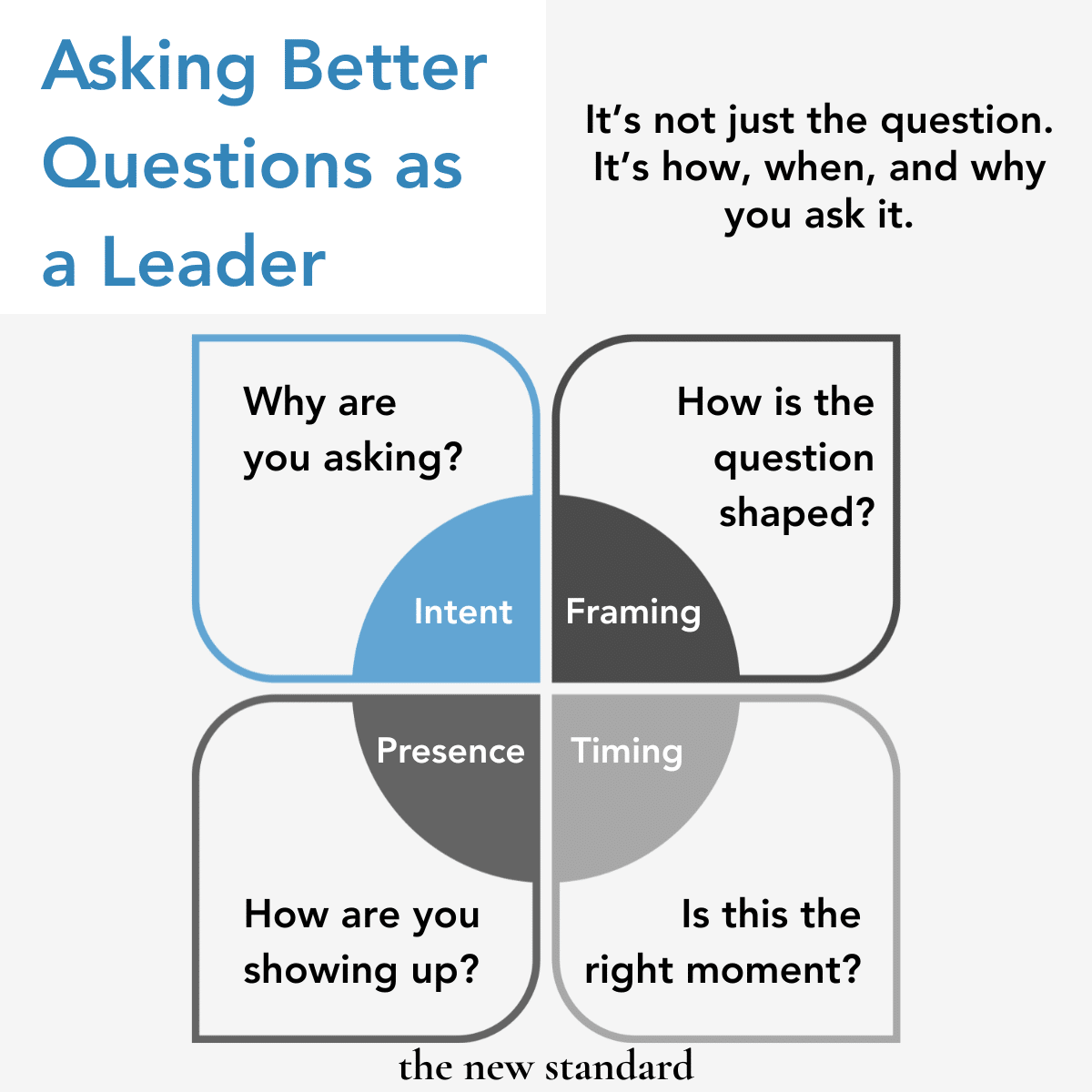
Asking better questions as a leader is a behavior shaped by four underlying dimensions: intent, framing, timing, and presence. Most leaders focus on the first part: what to say. But the real impact comes from everything surrounding it.
Intent: what’s driving the question
Every question carries intent, whether it’s obvious or not.
Some questions come from genuine curiosity, a real interest in how someone else is thinking. Others come from a quieter need to guide, confirm, or control the outcome of the conversation. On the surface, they can sound almost identical. In practice, they are received very differently.
A question asked from curiosity opens thinking. A question asked from control closes it.
You can feel the difference immediately. “What’s your take on this?” creates space. “Don’t you think we should go in this direction?” narrows it, even though both are technically questions.
Leaders don’t always realize when they’ve crossed that line. It often happens under pressure, or when there’s already a strong point of view in play. The question becomes less about discovery and more about validation.
But people notice, and when they do, they adjust. They give the safe answer, the one that’s expected of them and will keep things moving forward.
Curiosity, on the other hand, requires a willingness not to know, at least not right away. It asks the leader to stay open long enough for something new to emerge and that’s what makes it powerful.
Framing: how the question shapes the answer
Framing is where small shifts create big differences. The way a question is structured determines what kind of thinking is even possible in response.
“Who is responsible for this delay?”
“What conditions contributed to the timing shifting?”
Same issue. Completely different experience.
The first assigns fault before understanding context. The second surfaces what actually influenced the outcome.
Or:
“Is this the right approach?”
“What are the strengths and risks you see in this approach?”
One pushes toward a yes/no judgment. The other invites analysis and nuance.
These aren’t just semantic differences. They shape the entire conversation and signal whether the goal is compliance or insight.
| Instead of asking… | Try asking… | What changes |
| Why didn’t this get done? | What got in the way of this getting done? | Moves from blame → information-gathering |
| Do you agree? | How are you seeing this? | Invites perspective instead of alignment |
| Don’t you think we should…? | What options do you see here? | Removes bias and opens thinking |
| Is this on track? | What feels at risk right now? | Surfaces real issues earlier |
| Did you try X? | What approaches have you considered? | Encourages ownership |
Over time, framing shapes how people show up. If questions feel leading or evaluative, people respond cautiously. If they feel open, people think more out loud. And you have more opportunities to broaden your own thinking.
Timing: when a question helps, and when it doesn’t
There’s a tendency to treat questions as the better option in every situation, but not every moment is a question moment.
Questions work when there’s space for thinking: when the goal is insight, ownership, or perspective. They don’t work as well when clarity is needed quickly. If a team is navigating urgency or ambiguity, a question like “What do you think we should do?” can feel less like empowerment and more like the leader stepping back at the wrong time.
In those moments, direction is more useful than exploration, and strong leaders know the difference. They can sense when a situation calls for problem-solving and when it calls for clarity.
Presence: what makes a question real
Even when intent is clear, framing is strong, and timing is right, there’s still one factor that determines whether a question actually works: presence.
A question is not just what you say. It’s what you do after you say it. If a leader asks something and immediately fills the silence, redirects the answer, or signals what they were hoping to hear, the question stops being a question. It becomes a performance.
Presence looks like staying with the question. Letting silence do some of the work. Listening without interrupting or steering. People don’t just respond to the question itself; they respond to whether they believe it’s safe to answer honestly, and that sense of safety shapes everything that follows.
This is closely tied to psychological safety — something we intentionally embed into how leaders practice and develop these skills in our programs, not as theory, but as a working condition of the conversation itself. When people feel their perspective will be received openly, they’re more likely to share what’s actually true.
Without that, even the best questions fall flat.