
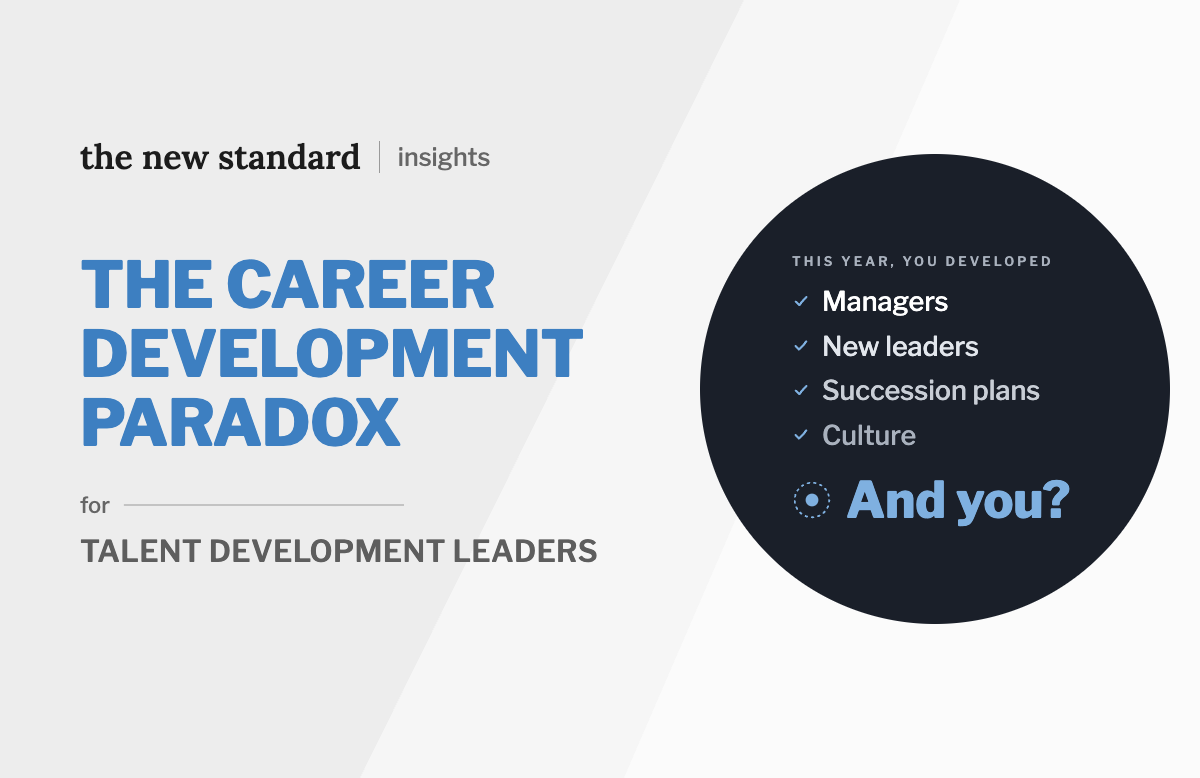
Talent development leaders spend their careers helping other people figure out what's next. They build leadership programs, guide career conversations, identify potential, and help people navigate the transitions that shape their professional lives.
But there's a question worth asking: Who is helping them do the same?
For many HR and talent development leaders, their own career development takes a back seat to the development of everyone around them. There's always another leadership program to launch, another succession plan to build, another executive to coach, or another organizational priority that needs attention.
Over time, it becomes easy to spend so much energy creating growth opportunities for others that your own growth becomes an afterthought.
It's a familiar paradox. And it has implications that go beyond finding time for professional development.
Knowing the questions doesn't mean you're asking them of yourself
Talent development professionals understand what intentional career development looks like. They know the importance of setting goals, seeking feedback, identifying skill gaps, and preparing for what's next.
They help other leaders do these things every day.
But applying that same discipline to your own career is a different challenge.
It's difficult to step outside your own professional identity and look objectively at where you are, where you want to go, and what's standing between the two. You're close to the decisions, relationships, expectations, and experiences that have shaped your career.
And the more successful you've been, the easier it can be to assume that what got you here will continue to get you where you want to go.
That's not always the case.
The behaviors that got you here may not get you there
Career progression often requires a shift in how you think, make decisions, and show up.
Consider the talent leader who built a reputation for being the person who gets things done. When a major initiative is at risk, they jump in, take ownership, and make sure nothing falls through the cracks.
It's a valuable strength. It's probably part of why they're successful.
But if their next step is leading an entire function, that same instinct to personally solve every problem may become a limitation. The next level requires creating direction, building capability in others, and influencing decisions beyond their immediate team.
Or consider the leader who has become indispensable to their organization. They're trusted, responsive, and always willing to take on more. But when an opportunity for advancement comes along, they're so embedded in their current responsibilities that it's difficult for others to envision them doing something different.
These aren't failures of capability. They're examples of how the behaviors associated with past success can become constraints on future growth.
The challenge isn't necessarily learning something new. Sometimes it's recognizing what needs to change.
Your default response under pressure matters
One of the most revealing places to look for these patterns is in how you respond when things get difficult.
Think about a recent moment in your career when something didn't go as planned. Maybe your budget was cut, a major initiative lost executive support, a promotion went to someone else, or you had to navigate a difficult conversation with a senior leader.
What did you do?
Did you push harder and take on more responsibility? Did you pull back and wait for things to settle? Did you give in to expectations that weren't aligned with what you actually wanted?
More importantly, what were you telling yourself in that moment?
Perhaps it was, "If I don't fix this, they'll think I'm not capable."
Or, "Now isn't the right time to ask for more."
Or, "I just need to get through this quarter."
These internal narratives can influence decisions in ways we don't always recognize. They shape how we respond to pressure, what opportunities we pursue, and which conversations we avoid.
Over time, those responses can become patterns. And patterns can keep us operating within the boundaries of an identity we've already outgrown.
Recognizing those patterns is an important part of determining what comes next.
Three questions worth asking about your own career

You don't need a new development plan to start thinking differently about your career. You need some space to step back and ask better questions.
Here are three places to start.
1. What do I actually want my next chapter to look like?
Not what the logical next promotion would be. Not what your organization needs from you. Not what would look good on your résumé.
What kind of work do you want to be doing? What kind of influence do you want to have? What responsibilities do you want to take on, and which ones are you ready to leave behind?
Be specific. A vague desire to advance makes it difficult to recognize the decisions that will move you forward.
2. What am I doing today that might be keeping me where I am?
Look beyond the obvious barriers. Consider the habits, assumptions, and behaviors that have become part of how you operate.
Are you spending too much time executing and not enough time influencing? Are you waiting to be recognized instead of advocating for your own development? Are you holding on to responsibilities because being indispensable feels safer than creating space for something new?
Sometimes the most important development opportunity is recognizing a behavior you need to change.
3. What do I consistently do when I'm under pressure?
Think about the situations that trigger your most automatic responses.
Do you take control? Avoid conflict? Overcommit? Retreat? Try to prove your value?
Then ask yourself whether that response is helping you move toward your longer-term goals or simply helping you get through the immediate situation.
The distinction matters. A response can solve today's problem while creating tomorrow's limitation.
Development requires a different kind of conversation
Self-reflection is a useful starting point, but it's not always enough.
We all have blind spots. We develop explanations for our decisions and become accustomed to the ways we operate. Sometimes we need someone outside our immediate environment to help us see what we're missing.
That's one of the reasons peer conversations can be so valuable.
A conversation with someone who understands the demands of your role, but doesn't work inside your organization, offers a different perspective. They can challenge assumptions, recognize patterns, and ask questions that colleagues may not think to ask.
It also creates something that can be surprisingly difficult to find in a demanding leadership role: dedicated time to think about your own development without being responsible for anyone else's.
For talent development leaders, that kind of space is worth protecting.
After all, the people responsible for helping others grow should have opportunities to do the same.
It's time to put your own development on the agenda
On November 18, The New Standard is bringing together HR and Talent Development leaders for its Quarterly Talent Development Roundtable: Leading Your Own Development.
This three-hour virtual experience is designed specifically for the people who spend their days developing others.
Rather than a traditional webinar or a series of presentations, the roundtable centers on candid conversation, peer perspective, and practical coaching.
Participants will hear from four experienced leaders during a panel discussion about real moments in their careers, including the decisions, challenges, and turning points that shaped their paths.
Then, in small groups led by ICF-certified executive coaches, participants will use TNS's Leadership Identity Map to examine a real moment from their own careers.
They'll explore the goals they're working toward, the triggers that influence their behavior, and the assumptions that may be getting in the way. They'll leave with a personal catch question, a concrete next step, and a framework for continuing their development.
You spend a lot of time thinking about how to help other people become better leaders. It's worth setting aside a little time to think about the leader you're becoming, too.